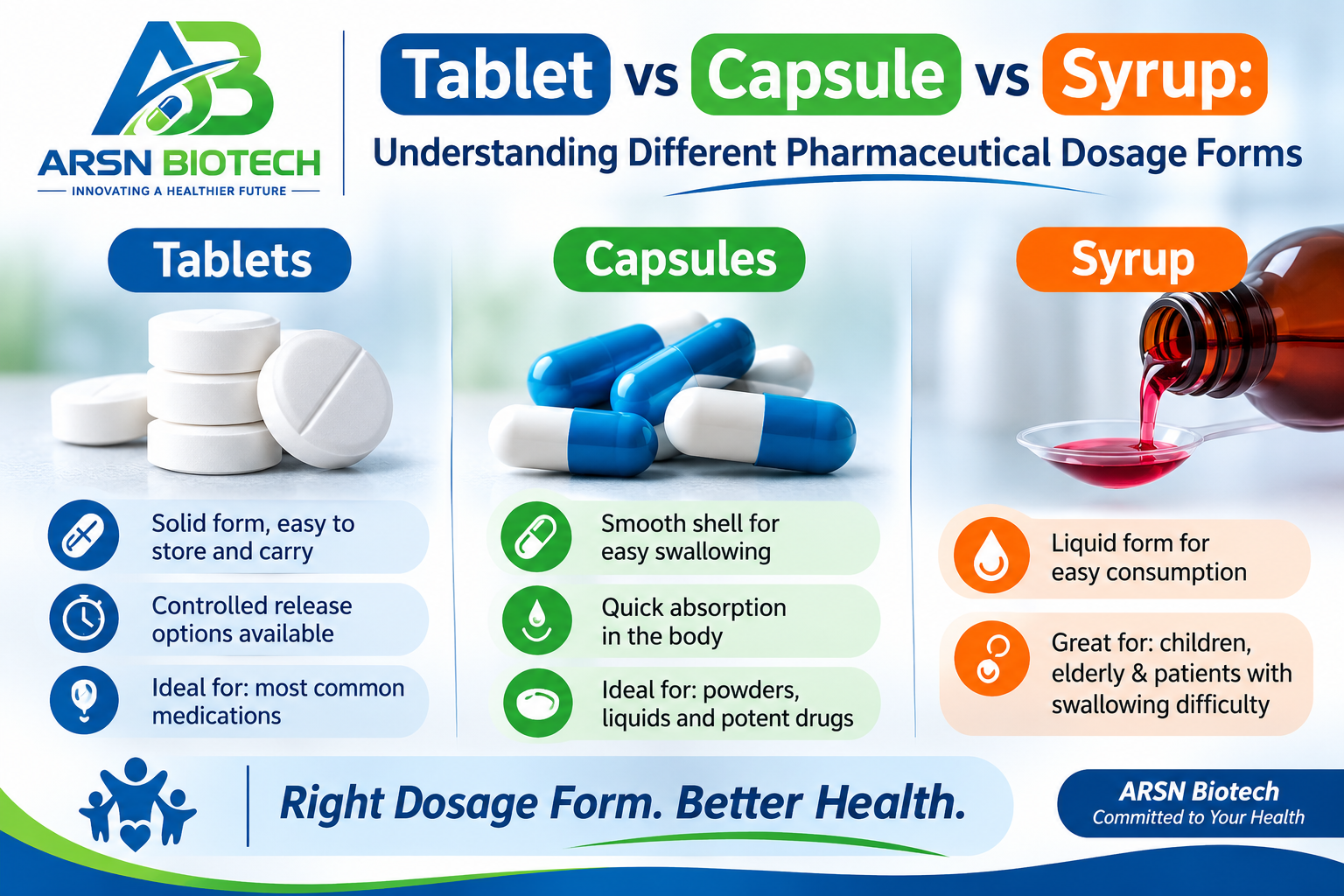
Pharmaceutical products are available in different dosage forms to meet various patient requirements and administration preferences. Tablets, capsules and syrups are among the most commonly used pharmaceutical dosage forms in the healthcare industry.
Each dosage form has its own characteristics, formulation requirements, manufacturing processes and packaging considerations. Selecting an appropriate dosage form is an important part of pharmaceutical product development because it can influence product stability, ease of administration, patient acceptability and overall product quality.
For pharmaceutical brands and businesses working with third-party manufacturing companies, understanding these dosage forms can help in making informed product development decisions.
In this article, we will explore the differences between tablets, capsules and syrups, their characteristics, manufacturing considerations and importance in the pharmaceutical industry.
1. What Are Pharmaceutical Dosage Forms?
Pharmaceutical dosage forms refer to the physical forms in which medicines are prepared and supplied for administration.
The active pharmaceutical ingredient (API), along with suitable excipients, is formulated into a particular dosage form to support accurate administration, stability and product performance.
Common pharmaceutical dosage forms include:
- Tablets
- Capsules
- Syrups
- Suspensions
- Dry syrups
- Injections
- Ointments
- Creams
- Gels
The selection of a dosage form depends on several factors, including the properties of the active ingredient, intended route of administration, patient requirements and product formulation.
2. Tablets: A Common Pharmaceutical Dosage Form
Tablets are solid pharmaceutical dosage forms generally prepared by compressing a mixture of active pharmaceutical ingredients and suitable excipients.
They are widely used across different therapeutic categories and are available in several formulations.
Types of Tablets
Some commonly used tablet types include:
- Immediate-release tablets
- Extended-release tablets
- Enteric-coated tablets
- Chewable tablets
- Dispersible tablets
- Sublingual tablets
Each type is designed with specific formulation and release characteristics.
Manufacturing Considerations
Tablet manufacturing generally involves several stages:
- Raw material selection and dispensing.
- Mixing and blending.
- Granulation, where required.
- Drying and lubrication.
- Compression.
- Coating, where applicable.
- Quality control testing.
- Packaging and labelling.
Manufacturing parameters such as tablet hardness, weight variation, disintegration and dissolution are important quality considerations, depending on the product specifications.
Advantages of Tablets
- Convenient to store and transport.
- Suitable for precise unit-dose administration.
- Available in different strengths and formulations.
- Generally offer good physical stability when properly formulated and packaged.
- Suitable for large-scale manufacturing.
3. Capsules: Flexible and Convenient Formulations
Capsules are pharmaceutical dosage forms in which active ingredients are enclosed within a shell.
They are commonly available as hard-shell and soft-gelatin capsules.
Types of Capsules
Hard Gelatin Capsules: These generally consist of two separate parts and are commonly used for powders, granules and certain other formulations.
Soft Gelatin Capsules: These are flexible, sealed capsules commonly used for oils and liquid or semi-solid formulations.
Capsule shell materials may include gelatin or suitable non-gelatin alternatives, depending on formulation requirements.
Capsule Manufacturing Process
The manufacturing process depends on the capsule type and formulation.
For hard-shell capsules, typical stages include:
- Ingredient dispensing.
- Powder or granule preparation.
- Blending.
- Capsule filling.
- Capsule inspection.
- Quality control testing.
- Packaging.
For soft-gelatin capsules, shell preparation, filling, sealing and drying are additional important manufacturing stages.
Advantages of Capsules
- Convenient to administer.
- Can help mask unpleasant tastes and odours.
- Available in different sizes and formulations.
- Suitable for certain powder, granule and liquid formulations.
- Offer flexibility in product development.
4. Syrups: Liquid Pharmaceutical Formulations
Syrups are liquid oral pharmaceutical preparations that generally contain dissolved ingredients in a suitable vehicle, often with sweetening agents.
They are commonly developed for patients who may find swallowing solid dosage forms difficult.
Types of Liquid Oral Formulations
Common liquid oral pharmaceutical products include:
- Syrups
- Oral solutions
- Oral suspensions
- Dry syrups
These formulations have different physical and chemical characteristics.
For example, an oral solution contains dissolved ingredients, while a suspension contains dispersed particles that may require shaking before administration.
Dry syrups are supplied in powder or granule form and are generally reconstituted with a specified quantity of liquid before use.
Syrup Manufacturing Process
A typical syrup manufacturing process may include:
- Raw material dispensing.
- Preparation of the liquid vehicle.
- Dissolution or dispersion of ingredients.
- Mixing and homogenisation, where required.
- Filtration, where appropriate.
- Quality control testing.
- Filling into suitable containers.
- Labelling and packaging.
The process varies according to the formulation and product specifications.
Advantages of Syrups
- Convenient for patients who have difficulty swallowing tablets or capsules.
- Allow flexible administration according to prescribed doses.
- Available in different flavours and formulations.
- Suitable for certain oral pharmaceutical products.
5. Difference Between Tablets, Capsules and Syrups
Although all three are commonly used pharmaceutical dosage forms, they differ in their physical characteristics, manufacturing requirements and packaging needs.
| Parameter | Tablets | Capsules | Syrups |
|---|---|---|---|
| Physical form | Solid | Solid shell | Liquid |
| Administration | Oral | Oral | Oral |
| Manufacturing | Compression-based | Filling and encapsulation | Mixing and liquid processing |
| Packaging | Blister or bottle | Blister or bottle | Bottles |
| Storage | Product-specific | Product-specific | Product-specific |
| Formulation | API and excipients | Ingredients enclosed in a shell | Ingredients in a liquid vehicle |
The most appropriate dosage form depends on the formulation, product characteristics and intended use.
6. Importance of Quality Control in Pharmaceutical Manufacturing
Quality control is an essential part of pharmaceutical manufacturing. Each dosage form requires appropriate testing to ensure that the finished product meets its established specifications.
Some important quality considerations include:
Tablet Quality Testing
- Weight variation
- Hardness
- Friability
- Disintegration
- Dissolution
- Assay and content uniformity, as applicable
Capsule Quality Testing
- Weight variation
- Disintegration
- Dissolution, where applicable
- Assay and content uniformity
- Capsule integrity
Syrup Quality Testing
- Appearance
- pH
- Viscosity, where applicable
- Assay
- Microbial quality
- Fill volume
The specific tests and acceptance criteria depend on the formulation, applicable pharmacopoeial requirements and approved product specifications.
7. Choosing the Right Dosage Form for Your Pharmaceutical Brand
Selecting the right dosage form is an important business and product development decision.
Pharmaceutical businesses should consider the following factors:
1. Product Formulation: The properties of the active ingredient influence which dosage forms are technically suitable.
2. Target Patient Group: Patient age, administration preferences and ability to swallow may influence dosage form selection.
3. Product Stability: Different dosage forms have different stability and storage requirements.
4. Manufacturing Capabilities: The manufacturing facility should have suitable equipment and processes for the intended product.
5. Packaging Requirements: Packaging must be selected according to product characteristics and stability requirements.
6. Regulatory Compliance: Product development and manufacturing should follow applicable regulatory requirements and approved specifications.
Working with an experienced pharmaceutical manufacturing partner can help businesses evaluate these factors during product development.
8. Role of Third-Party Pharmaceutical Manufacturing
Third-party pharmaceutical manufacturing allows pharmaceutical brands to outsource product manufacturing to an external manufacturing partner.
This arrangement can support businesses that want to develop and market pharmaceutical products without establishing their own manufacturing facility.
Depending on the manufacturer’s capabilities and regulatory approvals, available dosage forms may include:
- Tablets
- Capsules
- Syrups
- Dry syrups
- Injections
- Ointments and creams
Before selecting a manufacturing partner, businesses should evaluate manufacturing capabilities, product-specific licences, quality systems, documentation, production capacity and applicable regulatory compliance.
Clear communication about formulation requirements, packaging, batch size and product specifications is important for a smooth manufacturing process.
9. How ARSN Biotech Supports Pharmaceutical Product Manufacturing
ARSN Biotech operates in the pharmaceutical, nutraceutical, Ayurvedic and food product segments.
Based in the Mohali–Tricity region of Punjab, ARSN Biotech works in pharmaceutical and allied product manufacturing, including third-party manufacturing and contract manufacturing opportunities.
The company focuses on supporting businesses looking to develop and manufacture products across different categories.
For businesses exploring pharmaceutical product development, understanding the available dosage forms is an important first step.
The appropriate manufacturing and product development approach depends on the formulation, technical requirements and applicable regulatory permissions.
Visit the official website to learn more:
Conclusion
Tablets, capsules and syrups are three important pharmaceutical dosage forms, each offering different formulation and manufacturing characteristics.
While tablets are commonly manufactured through compression, capsules involve enclosing ingredients within a suitable shell, and syrups require liquid formulation and processing.
Choosing the right dosage form involves considering formulation suitability, patient requirements, stability, manufacturing capabilities, packaging and regulatory compliance.
For pharmaceutical businesses planning to expand their product portfolios, understanding these differences can support better product development and manufacturing decisions.