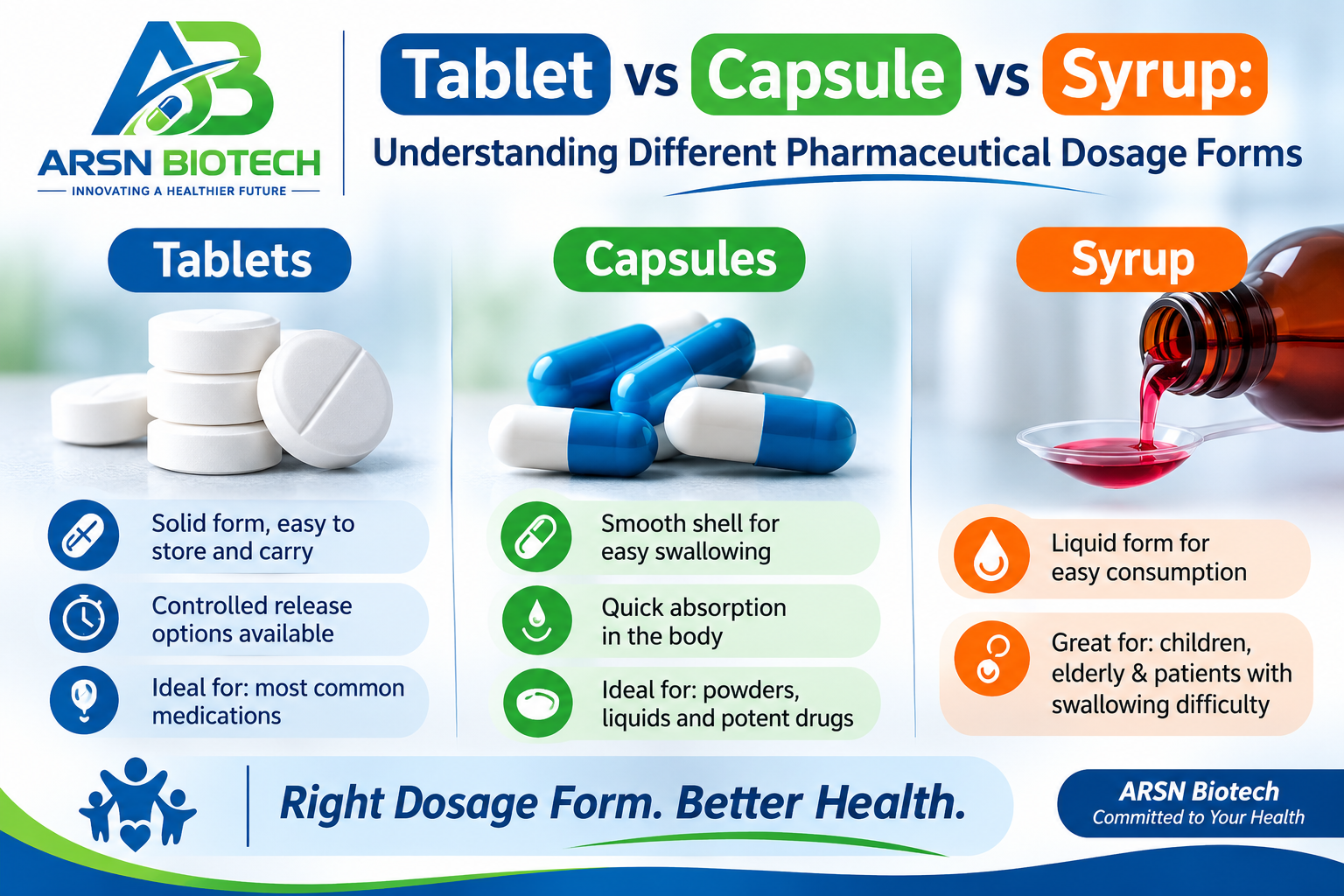
Tablet vs Capsule vs Syrup: Understanding Different Pharmaceutical Dosage Forms
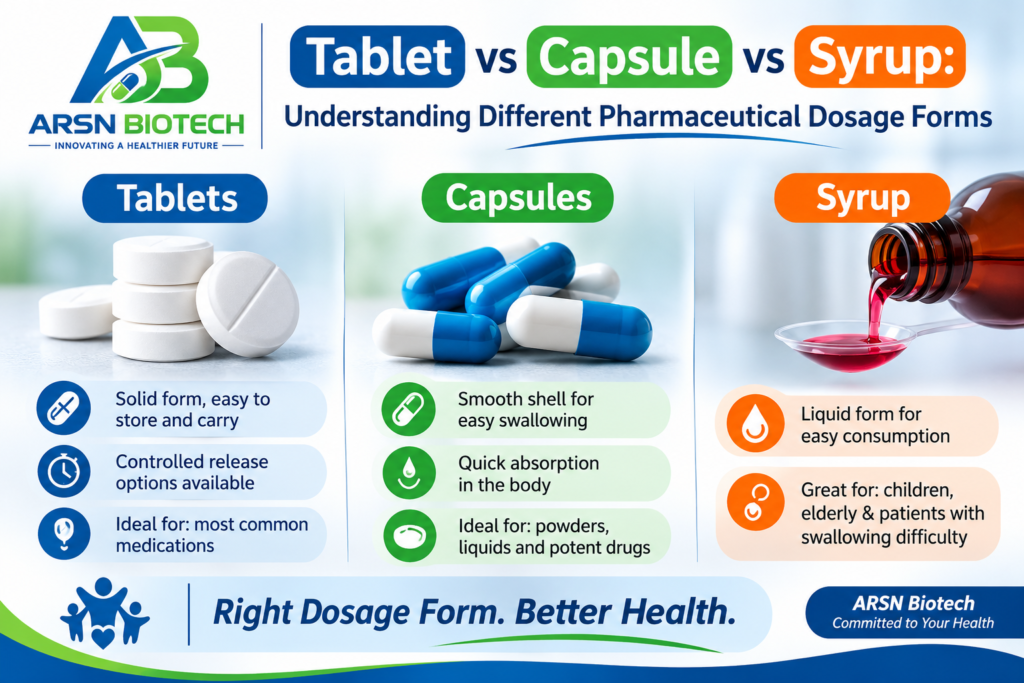
Pharmaceutical products are available in different dosage forms to meet various patient requirements and administration preferences. Tablets, capsules and syrups are among the most commonly used pharmaceutical dosage forms in the healthcare industry. Each dosage form has its own characteristics, formulation requirements, manufacturing processes and packaging considerations. Selecting an appropriate dosage form is an important part of pharmaceutical product development because it can influence product stability, ease of administration, patient acceptability and overall product quality. For pharmaceutical brands and businesses working with third-party manufacturing companies, understanding these dosage forms can help in making informed product development decisions. In this article, we will explore the differences between tablets, capsules and syrups, their characteristics, manufacturing considerations and importance in the pharmaceutical industry. 1. What Are Pharmaceutical Dosage Forms? Pharmaceutical dosage forms refer to the physical forms in which medicines are prepared and supplied for administration. The active pharmaceutical ingredient (API), along with suitable excipients, is formulated into a particular dosage form to support accurate administration, stability and product performance. Common pharmaceutical dosage forms include: Tablets Capsules Syrups Suspensions Dry syrups Injections Ointments Creams Gels The selection of a dosage form depends on several factors, including the properties of the active ingredient, intended route of administration, patient requirements and product formulation. 2. Tablets: A Common Pharmaceutical Dosage Form Tablets are solid pharmaceutical dosage forms generally prepared by compressing a mixture of active pharmaceutical ingredients and suitable excipients. They are widely used across different therapeutic categories and are available in several formulations. Types of Tablets Some commonly used tablet types include: Immediate-release tablets Extended-release tablets Enteric-coated tablets Chewable tablets Dispersible tablets Sublingual tablets Each type is designed with specific formulation and release characteristics. Manufacturing Considerations Tablet manufacturing generally involves several stages: Raw material selection and dispensing. Mixing and blending. Granulation, where required. Drying and lubrication. Compression. Coating, where applicable. Quality control testing. Packaging and labelling. Manufacturing parameters such as tablet hardness, weight variation, disintegration and dissolution are important quality considerations, depending on the product specifications. Advantages of Tablets Convenient to store and transport. Suitable for precise unit-dose administration. Available in different strengths and formulations. Generally offer good physical stability when properly formulated and packaged. Suitable for large-scale manufacturing. 3. Capsules: Flexible and Convenient Formulations Capsules are pharmaceutical dosage forms in which active ingredients are enclosed within a shell. They are commonly available as hard-shell and soft-gelatin capsules. Types of Capsules Hard Gelatin Capsules: These generally consist of two separate parts and are commonly used for powders, granules and certain other formulations. Soft Gelatin Capsules: These are flexible, sealed capsules commonly used for oils and liquid or semi-solid formulations. Capsule shell materials may include gelatin or suitable non-gelatin alternatives, depending on formulation requirements. Capsule Manufacturing Process The manufacturing process depends on the capsule type and formulation. For hard-shell capsules, typical stages include: Ingredient dispensing. Powder or granule preparation. Blending. Capsule filling. Capsule inspection. Quality control testing. Packaging. For soft-gelatin capsules, shell preparation, filling, sealing and drying are additional important manufacturing stages. Advantages of Capsules Convenient to administer. Can help mask unpleasant tastes and odours. Available in different sizes and formulations. Suitable for certain powder, granule and liquid formulations. Offer flexibility in product development. 4. Syrups: Liquid Pharmaceutical Formulations Syrups are liquid oral pharmaceutical preparations that generally contain dissolved ingredients in a suitable vehicle, often with sweetening agents. They are commonly developed for patients who may find swallowing solid dosage forms difficult. Types of Liquid Oral Formulations Common liquid oral pharmaceutical products include: Syrups Oral solutions Oral suspensions Dry syrups These formulations have different physical and chemical characteristics. For example, an oral solution contains dissolved ingredients, while a suspension contains dispersed particles that may require shaking before administration. Dry syrups are supplied in powder or granule form and are generally reconstituted with a specified quantity of liquid before use. Syrup Manufacturing Process A typical syrup manufacturing process may include: Raw material dispensing. Preparation of the liquid vehicle. Dissolution or dispersion of ingredients. Mixing and homogenisation, where required. Filtration, where appropriate. Quality control testing. Filling into suitable containers. Labelling and packaging. The process varies according to the formulation and product specifications. Advantages of Syrups Convenient for patients who have difficulty swallowing tablets or capsules. Allow flexible administration according to prescribed doses. Available in different flavours and formulations. Suitable for certain oral pharmaceutical products. 5. Difference Between Tablets, Capsules and Syrups Although all three are commonly used pharmaceutical dosage forms, they differ in their physical characteristics, manufacturing requirements and packaging needs. Parameter Tablets Capsules Syrups Physical form Solid Solid shell Liquid Administration Oral Oral Oral Manufacturing Compression-based Filling and encapsulation Mixing and liquid processing Packaging Blister or bottle Blister or bottle Bottles Storage Product-specific Product-specific Product-specific Formulation API and excipients Ingredients enclosed in a shell Ingredients in a liquid vehicle The most appropriate dosage form depends on the formulation, product characteristics and intended use. 6. Importance of Quality Control in Pharmaceutical Manufacturing Quality control is an essential part of pharmaceutical manufacturing. Each dosage form requires appropriate testing to ensure that the finished product meets its established specifications. Some important quality considerations include: Tablet Quality Testing Weight variation Hardness Friability Disintegration Dissolution Assay and content uniformity, as applicable Capsule Quality Testing Weight variation Disintegration Dissolution, where applicable Assay and content uniformity Capsule integrity Syrup Quality Testing Appearance pH Viscosity, where applicable Assay Microbial quality Fill volume The specific tests and acceptance criteria depend on the formulation, applicable pharmacopoeial requirements and approved product specifications. 7. Choosing the Right Dosage Form for Your Pharmaceutical Brand Selecting the right dosage form is an important business and product development decision. Pharmaceutical businesses should consider the following factors: 1. Product Formulation: The properties of the active ingredient influence which dosage forms are technically suitable. 2. Target Patient Group: Patient age, administration preferences and ability to swallow may influence dosage form selection. 3. Product Stability: Different dosage forms have different stability and storage requirements. 4. Manufacturing Capabilities: The manufacturing facility should have suitable equipment and processes for the intended product. 5. Packaging Requirements:
How to Choose the Best Third Party Pharma Manufacturing Company in India

Learn how to choose the best third party pharma manufacturing company in India. Compare quality standards, licences, product range, MOQ, pricing and delivery.